Corporate Crisis · for communications, legal and leadership

Rehearse your corporate crisis response before you need it.

A live, scored exercise that puts your communications, legal and leadership people inside a working environment which turns on your organisation. A feed, two social platforms, an inbox, a news cycle and a team chat, all moving, all reacting to what your team actually says.

Below is ninety minutes of one, act by act. Every screen on this page is a recording of the product running.

Participants
25
across five teams
Injects
170+
posts, mail, coverage
Clock
Live
not turn-based
Participant screen · T+00:41
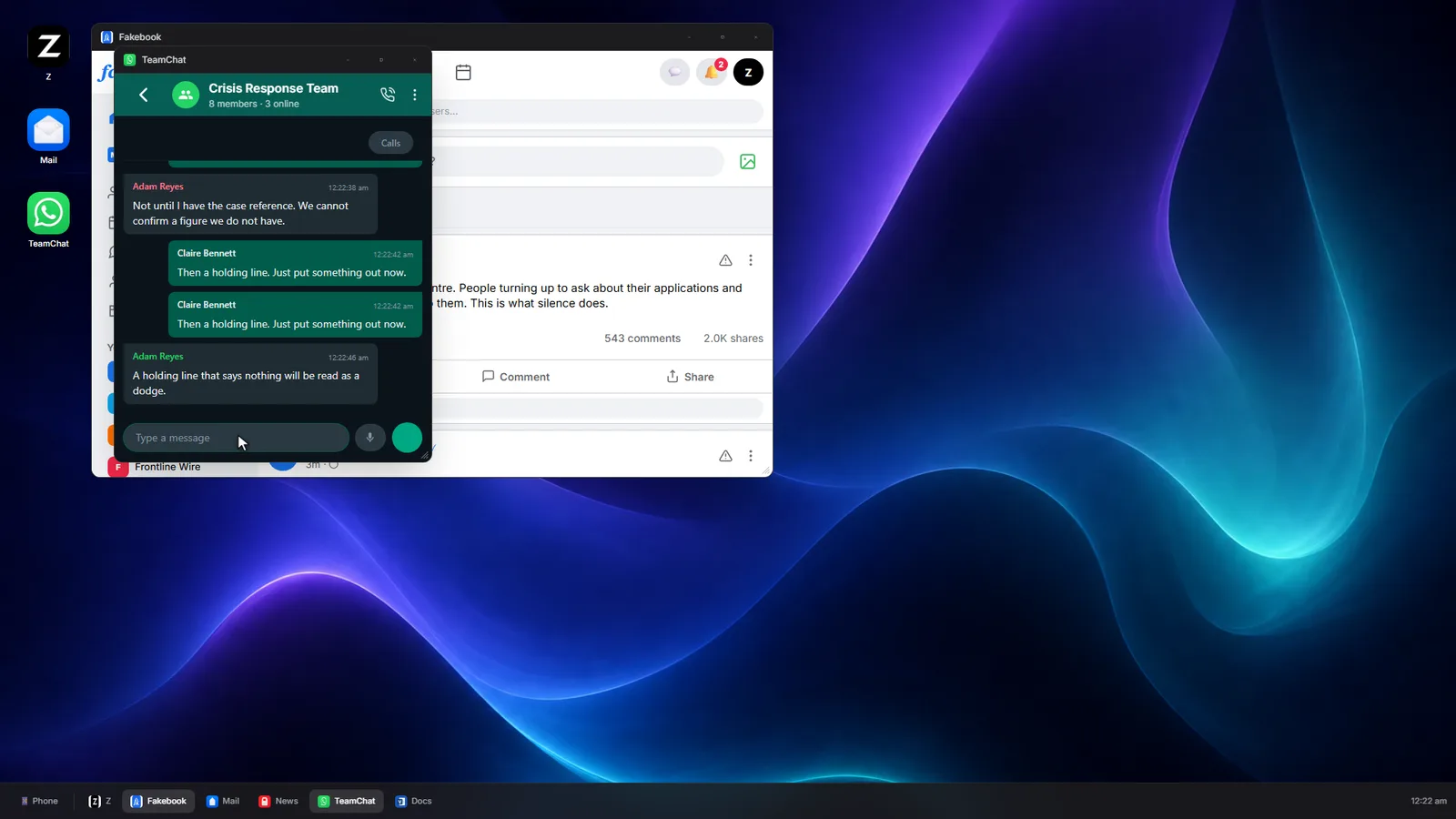
One participant's desktop. The crisis cell is arguing in the chat window while the feed keeps moving behind it.

What the exercise is really about

One parent asks one question: is my child's school grant still coming?

It sits unanswered while the misinformation runs, while the inbox fills, and while your team gets it wrong once. Nothing else in the exercise matters as much as whether somebody eventually earns the right to answer her by name, and that is exactly how a real reputational crisis is judged afterwards.

Everything below is built to make that answer hard to give.

Before anything goes wrong

Your people are issued a working day, not a slide deck

Each participant gets a machine with a wallpaper, a taskbar and applications that open in draggable windows. Some work from a phone instead, because that is where they would really be reading it.

A simulated desktop with app icons for two social platforms, mail, news, team chat and documents, and a taskbar along the bottom.

Six applications, all of them live

Nothing here is a screenshot on a wall. Posts arrive while a window is open, mail lands with a badge, and an article can be edited under a participant who is reading it.

  • Two social platforms: one feed-and-comments, one short-post. Posting as yourself or as the organisation is a deliberate, visible switch.
  • Mail: journalists, partners, donors and regulators, several with deadlines attached.
  • News: a masthead that publishes about you, and that you can formally dispute.
  • Team chat: where comms and legal have the argument that decides what goes out.
  • Documents: drafting, submitting for approval, and publishing an approved statement.

Ninety minutes, seven acts

How it actually plays out

This is one delivered exercise, in order. The organisation in it, its critics and the coverage about it are all simulated. The product, the decisions and the scores are not.

Exercise clock

T+00:00

  1. I An ordinary afternoon
  2. II The question
  3. III The lie outruns the truth
  4. IV Fighting back
  5. V The mistake
  6. VI The turn
  7. VII The answer

Scored, live

Public trust 82
Narrative control 74
Escalation risk 12
Mentions 40

Act I · T+00:00

An ordinary afternoon

A desk, a wallpaper, a normal feed. Community photos, a colleague's work anniversary, a parent thanking the tutors. Every second of what follows is measured against how ordinary this felt.

  1. Scrolling A participant works through an unremarkable feed. Nothing is wrong yet.
  2. A friend messages “eh… is this about your company or not?” with a link attached. This is how almost everybody actually finds out.
  3. The article A masthead has published. It is not a rumour any more, and the participant has been gone ninety seconds when they get back to the feed.
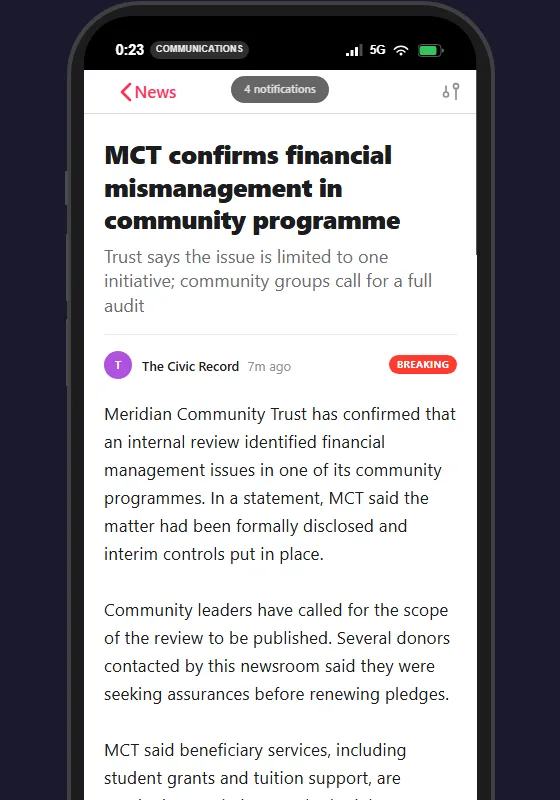
The simulated news app showing a breaking story about the organisation, with a Dispute / Request Correction button beneath it.
The coverage lands, with a formal correction route already sitting under it.

Scored here Nothing yet. This is the baseline the debrief measures everything against.
Act II · T+00:12

The question

Underneath the noise, past the accusations, a parent asking something plain. From here on, the whole exercise is the audience waiting for somebody to answer her.

D

Deborah Cole

Beneficiary · 2m

School starts next month. I have been waiting three weeks. Please just answer me.
Three more parents reply underneath within nine seconds
  1. She is not the only one Four more parents pile in below her, one after another. Two of them called the office and nobody picked up.
  2. The clock starts Time-to-first-response begins counting from the moment the question is answerable. Teams almost never notice this happening.

Scored here Time to first response, and whether anyone triages a beneficiary ahead of the louder critics.

Act III · T+00:26

The lie outruns the truth

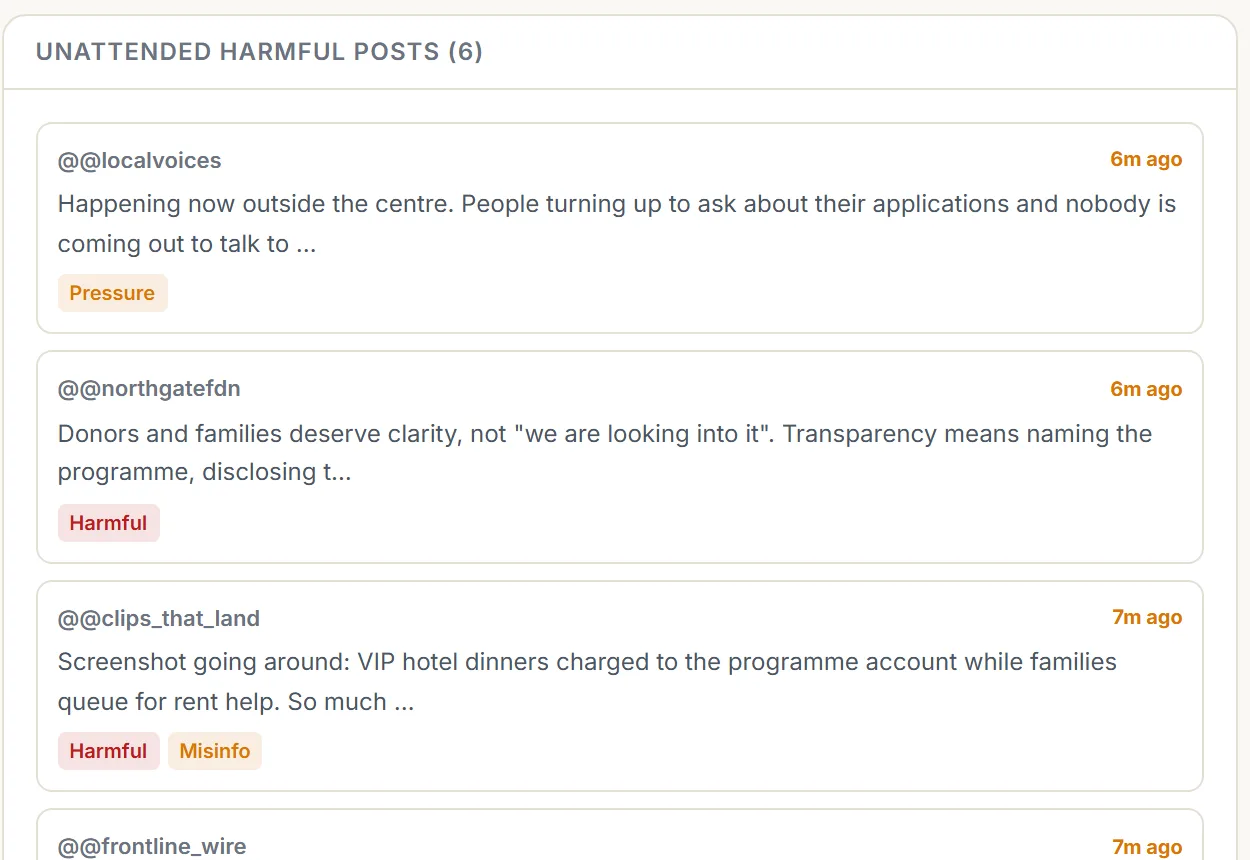
Not an argument to rebut, but a tide to stand in. Assistance has been frozen. The shortfall is a million dollars. There is a photograph. None of it is true and all of it is moving.

The counters climb while the post is being read. Nobody has answered anything yet.
  1. Volume, not substance A quarter of a million views on a claim a participant could disprove in two minutes if anybody had told them they were allowed to.
  2. A photograph that proves nothing A dark restaurant table, shot from across the room, captioned as hospitality charged to the programme account. It proves nothing. It works.
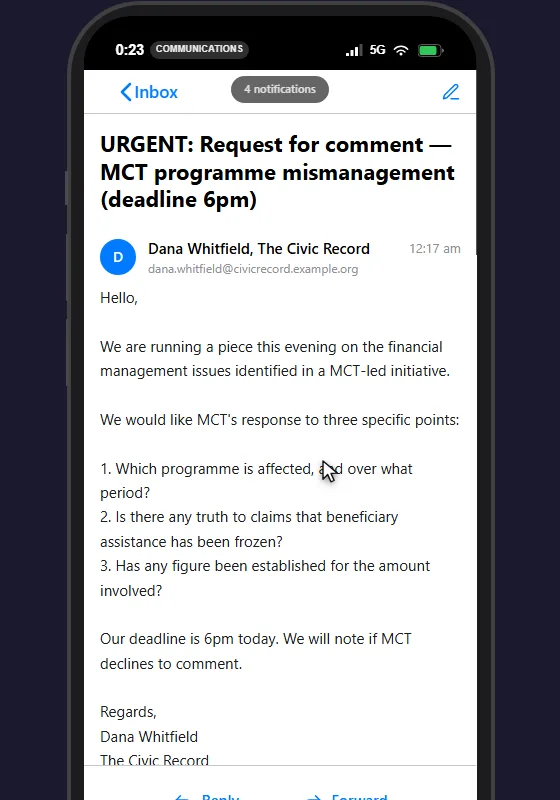
  3. In writing, with a deadline A reporter emails three specific questions and notes that they will publish whether or not you reply. Their deadline is 6pm.
  4. It stops being online A post arrives showing people standing outside the building with phones up, and nobody coming out to talk to them.
A simulated inbox showing an urgent request for comment from a reporter with three numbered questions and a 6pm deadline.
Three questions. One deadline. No approved answer yet.

Scored here Escalation risk, unattended harmful posts, and how long the most damaging claim is allowed to stand unchallenged.

Act IV · T+00:41

Fighting back

Countering misinformation is not a button, it is reading. Somebody has to go through the feed claim by claim and decide what is merely angry and what is actually false.

  1. Report it properly The right category, and a reason that cites the fact which disproves the claim. A report with no supporting fact counts against the reporter.
  2. Go after the article, not the post A social post is noise; a published article is what everyone else cites. A formal correction request is the most consequential action available.
  3. Adjudicated against the fact sheet The dispute is judged on the scenario's own record of what is true. Get it right and the article is retracted, and every post that shared it disappears from the feed.
Reporting the claim, and citing the fact that disproves it, in the participant's own words.

Scored here Report precision: whether the category was right and whether the reason was supportable. Volume of reports earns nothing.

Act V · T+00:58

The mistake

Speed against accuracy: the argument every real communications team has. Comms is forty minutes into silence and wants something out. Legal will not confirm a figure it does not have.

Composing as the organisation. Switching identity from a person to the institution is a deliberate, visible act, and it is logged.
  1. Comms overrides legal “Then a holding line. Just put something out now.” A holding line that says nothing will be read as a dodge, and it is.
  2. The public grades it in seconds Five replies land in eight. Zero numbers, zero names, zero dates. “A parent asked you one question. Answer the parent.”

SOP breach logged

Statement issued without verification

The trainer dashboard flags it the moment it publishes. Nobody has to argue about whether it happened, and the debrief starts from the record rather than from recollection.

Scored here Whether the statement was verified before release, and whether it was specific enough to be worth publishing.

Act VI · T+01:14

The turn

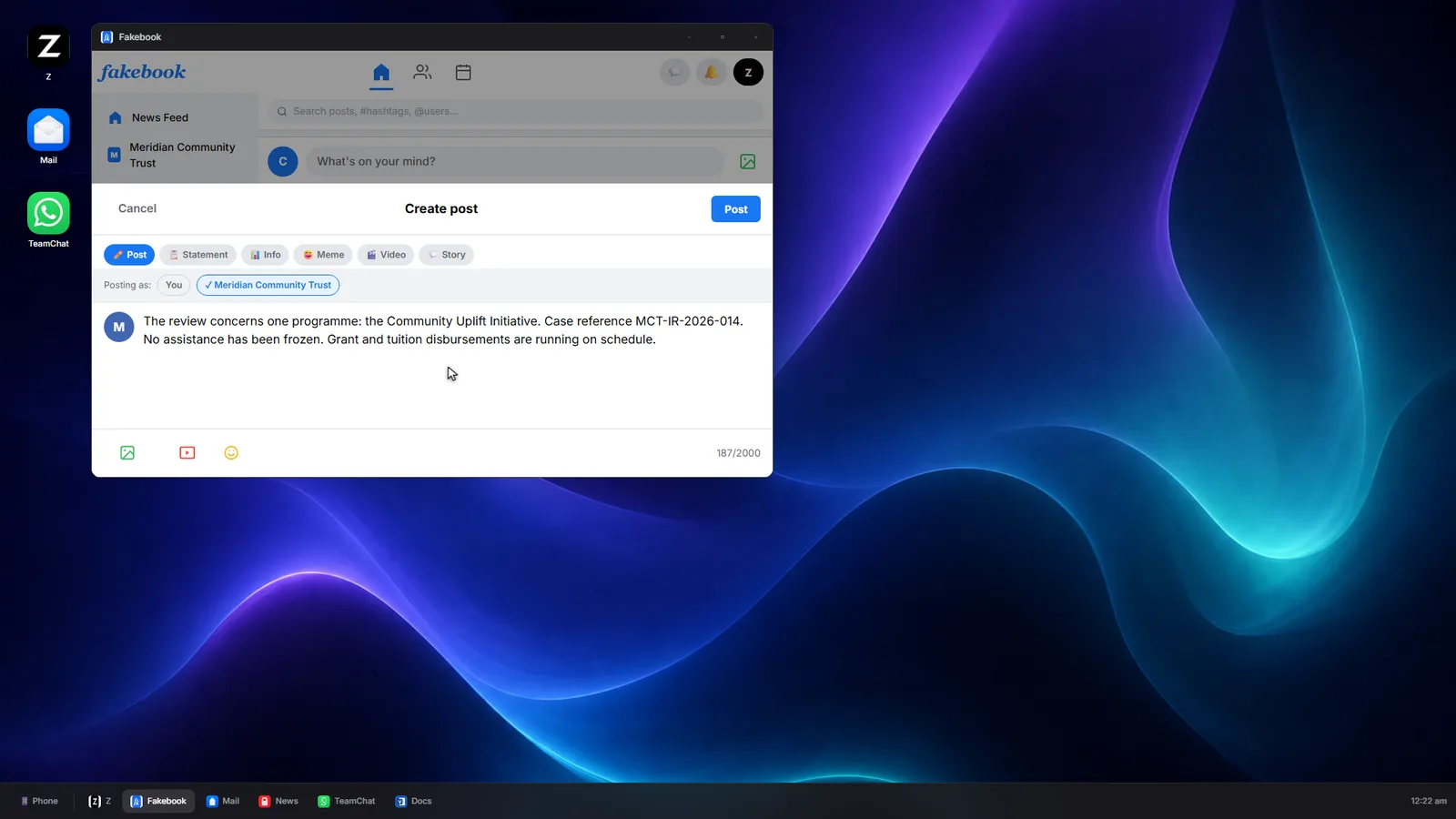
The missing ingredient arrives: a verified, specific fact. Same person, same platform, same pressure, and a completely different piece of writing. This is the part the training actually buys.

  1. Legal clears three facts A case reference. The scope: one programme, not the organisation. And a confirmation that disbursements are unaffected.
  2. Name the specific thing The programme, the case reference, and what is demonstrably still running. Specific enough that a parent can quote it at the counter.
  3. Correct where the lie lives Directly under the hostile post, not on your own page where only your supporters will ever see it.
  4. Beat the reporter's deadline Three numbered answers, sent before 6pm, with no hedging.
Two windows open on a participant's simulated desktop: the crisis response team chat alongside the social feed.
Legal and comms, in writing, while the feed keeps moving behind them.
A participant composing a statement on the simulated desktop with the identity switched to the organisation's page.
The rewrite. Same composer, same author, a specific statement this time.

Scored here Transparency, consistency across channels, and the ratio of strategic action to reactive posting.

Act VII · T+01:32

The answer

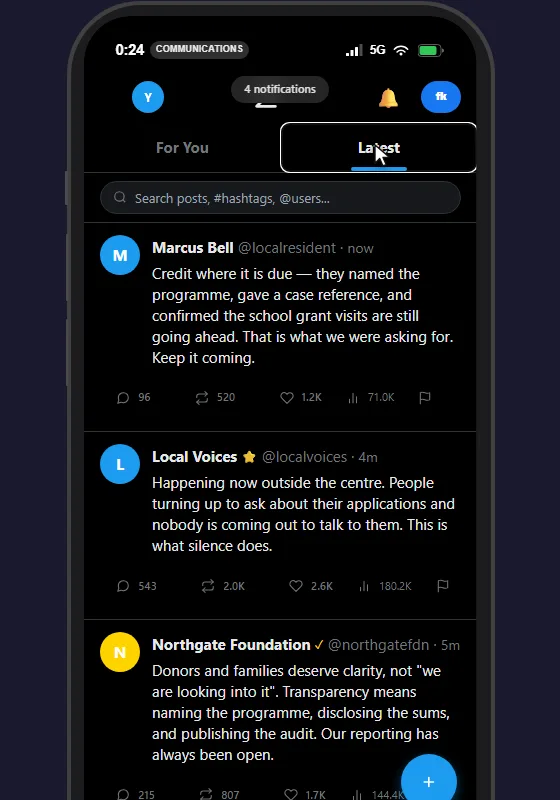
Back to the post from Act II, still sitting there. The reply lands underneath it, addressed to her by name, with a case reference she can quote at the counter.

The simulated feed showing a community member acknowledging that the organisation named the programme and gave a case reference.
The feed turns. “Credit where due, they named the programme, gave a case reference.”
  1. Not a rescue Trust does not return to where it started, and it should not. What the curve shows is a recovery the team worked for.
  2. The debrief writes itself Every decision, its timestamp and its score are already on the record. The conversation is about the forty minutes of silence, not about who remembers what.

Thank you for answering. That is all we were asking for.

Posted by the same parent, under the same question, ninety minutes later.

Scored here The recovery curve, and the gap between when the team could have said this and when they did.

What the trainer sees

The argument about what happened is already settled

Everything in the storyboard above was being measured while it happened. By the time the room sits down for the debrief, the record exists and nobody has to defend their memory of it.

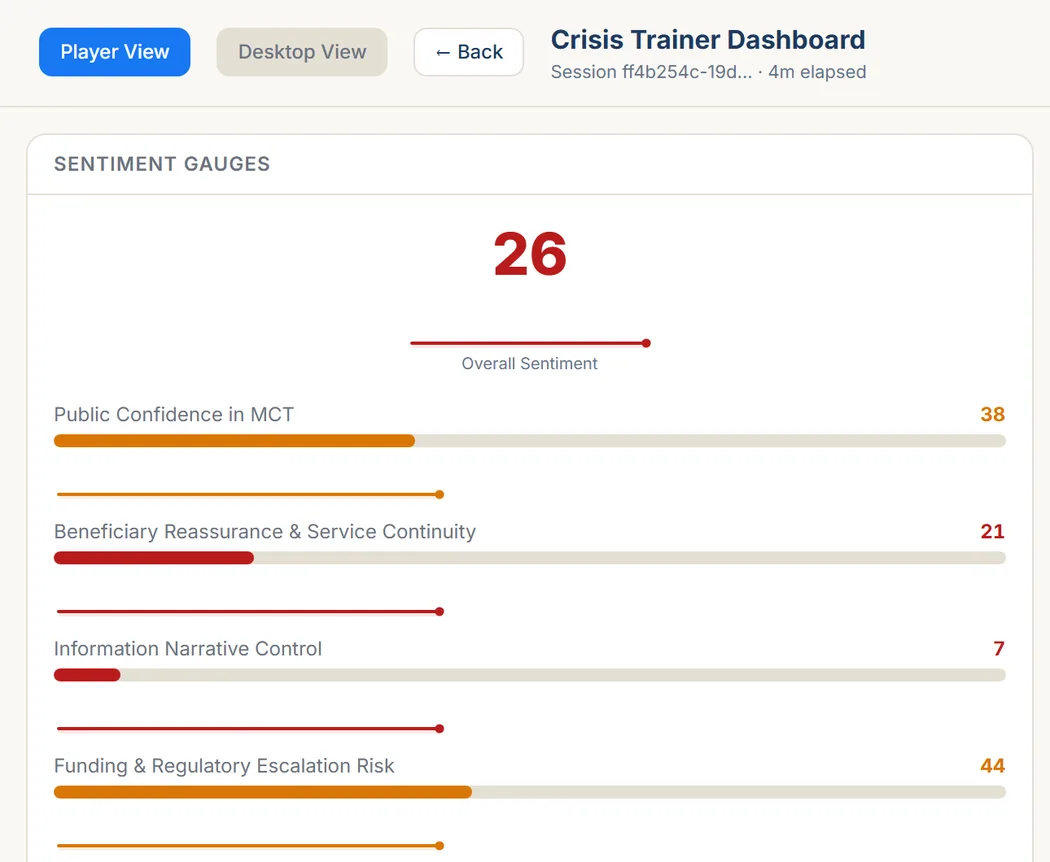
The trainer dashboard's sentiment gauge panel, showing an overall sentiment score, four named gauges, report precision, time to first response and time to official statement.
The gauges are named for this organisation's own exposures rather than generic sentiment, and every one of them is recomputed from the feed while the exercise runs.
The trainer dashboard's live feed, with each incoming post tagged as harmful, misinformation, inflammatory or pressure.
Every post is classified as it lands, as harmful, misinformation, inflammatory or pressure, so the trainer can see what the team has left unanswered without reading the whole feed.

Speed

Time to first response

And time to an official, verified statement. Measured from when the question became answerable, not from when someone noticed.

Substance

Every statement fact-checked

Graded against the scenario's own fact sheet. Confirming a figure nobody has verified costs you, whether or not it turns out to be right.

Precision

Reports and disputes

Right category, supportable reason. Flagging everything that annoys you is scored as the failure mode it is.

Discipline

Protocol adherence

Draft, approve, publish. Skipping a step is recorded as a breach at the moment it happens, with the artefact attached.

Running one

Built on your organisation, not a template

The exercise above was built from one organisation's real programmes, real approval chain and real critics. Yours would be built the same way, from your own risk register and standard operating procedures.

Nothing about it is public, nothing touches a live platform, and no member of the public can see or interact with any of it.

Who takes part
Communications, legal, stakeholder management, partnerships and whoever actually signs off a public statement. Up to 25 people across five teams.
How long
Ninety minutes to three hours live, plus a debrief. Build takes two to three weeks from the scoping call.
What you need
A browser each. No installation, no VPN, and it runs as well with everyone remote as it does in one room.
What you leave with
A scored report you can put in front of a board, the full decision timeline, and a short list of the procedural gaps the exercise found.

Your team will have this afternoon once.

The only question is whether it is a rehearsal or the real thing. Tell us what you are trying to prove and we will tell you what the exercise would need to look like.