We run a live, AI-scored crisis simulation for your team, built on your own risk
material. Your people make real decisions under pressure, every call is timed and
graded, and you leave with a report showing precisely where the response breaks.
One risk-built scenario, two live simulations, one scored review.
4 hrs
per live simulation
8–30
participants across your teams
Same day
scored after-action review
Inbox17
Regulator: briefing required
Confirm attendance within the hour
Press desk: filing 15:00
We are running the story regardless
Legal: hold that statement
Do not confirm cause yet
Site manager: headcount update
Duty officer: shift handover
Field operationsT+ 00:22:14
cordontriageevac
Evacuated
312 / 1,480
Cordon
Partial
Severity
Escalating
ZLive feedExercise
Trending: #Eastport18,402
PN
Priya Nathan@priya_nathan·2m
Three ambulances at the Eastport site and they are walking everyone out into
the car park. My sister works in that building and she is not picking up.
2141,9086,733412K
DK
Dan Kowalski★@dk_reports·7m
I worked Eastport six years. That line was flagged in an internal audit last
March and nothing was done. The document exists. They knew. 1/7
MisinformationUnverified
Virality94
3,10418,24142,8062.4M
Requires response04:38
MW
Metro Wire@metrowire·now
We run the Eastport story at 15:00 with the audit claim in it. No statement
by then and we report that the company declined to comment.
Your accountSilent 41 minEvery minute is scored
Illustrative interface views
Fictional, non-operational scenarios only. Built for government, defence, emergency
services, critical infrastructure, corporate crisis and communications teams.
What you get
One engagement, three deliverables
01
Build your crisis with professional risk consultants
Our risk consultants work with your team to turn your crisis plan, risk register
and standard operating procedures into a bespoke scenario. The exercise reflects
your sector, sites, stakeholders, dependencies and decision thresholds.
Your team validates the scenario before the first simulation begins.
02
Two live simulations
The first simulation establishes a performance baseline. A facilitated reflection
then converts the findings into practical adjustments before the second simulation
tests whether those changes improve performance under pressure.
Baseline, facilitated reflection, retest and measured improvement.
03
A scored after-action review
Receive a scored account of what happened, including decision latency,
coordination, team and participant performance, the complete decision timeline and
prioritised recommendations. Exported to PDF or Excel.
Evidence generated from the simulations, not reconstructed from memory.
Every engagement includes all three
Scope, format and dates are agreed with you at the scoping call, before anything is
built. Your organisation is invoiced directly and pays online, so nobody on your team
needs an account with us.
Your crisis material is never used to train an AI model
A realistic exercise means handing us your risk register, your escalation
thresholds and the things your executives would actually say at three in the
morning. That material is treated as what it is: some of the most sensitive
information your organisation holds.
No training, no fine-tuning
Your scenario material and every decision made during a simulation are processed
to run your exercise and nothing else. They are never used to train or fine-tune
any model, ours or a vendor’s.
Private inference on AWS
Language models run through Amazon Bedrock. Prompts and responses are not shared
with the model providers and are not retained by them. That is an AWS contractual
commitment, not a setting we toggle.
In-region and isolated
Your data stays in the AWS region agreed with you at scoping. Each
client’s material is kept separate; nothing is pooled across engagements.
Yours to remove
Request a full export or permanent deletion of everything from an engagement at
any point, during or after it.
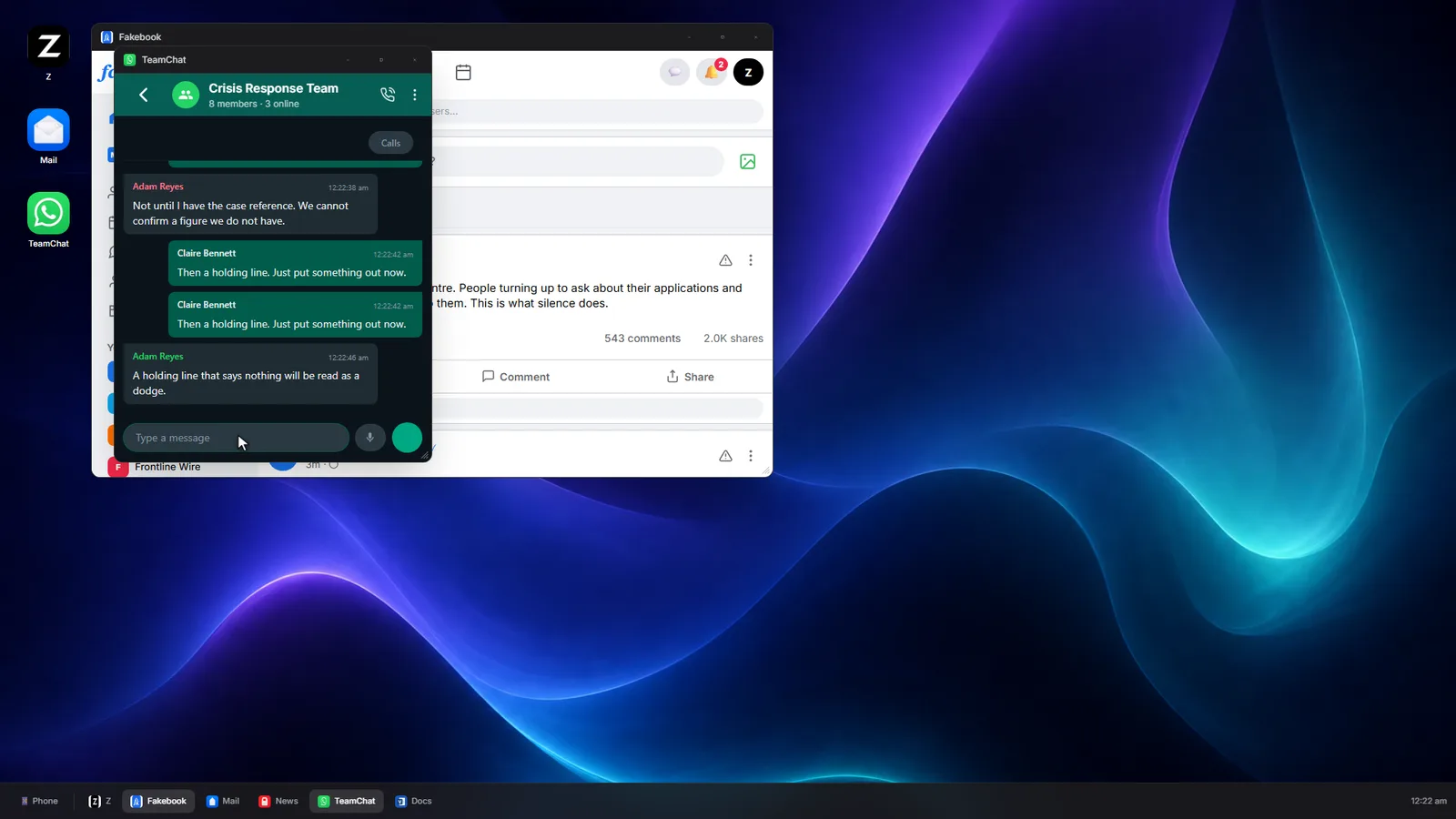
Recorded · Communications lead · T+00:58
Forty minutes into the silence, a communications lead writes the organisation's first
public statement. Legal has not cleared a figure. It publishes anyway.
Corporate Crisis · recorded, not mocked up
What it looks like from inside the room
Your people are issued a working environment of two social platforms, an inbox, a
news cycle and a team chat. Then it turns on your organisation. Misinformation
moves faster than your approval chain, and every decision is timed and scored while
they make it.
Posts, messages and coverage arrive live while a window is open. Nothing is
pre-baked into a slide.
Hostile accounts respond to what your team actually says, not to a script
written in advance.
Every public statement is checked against the scenario's own record of what is
true.
The feed
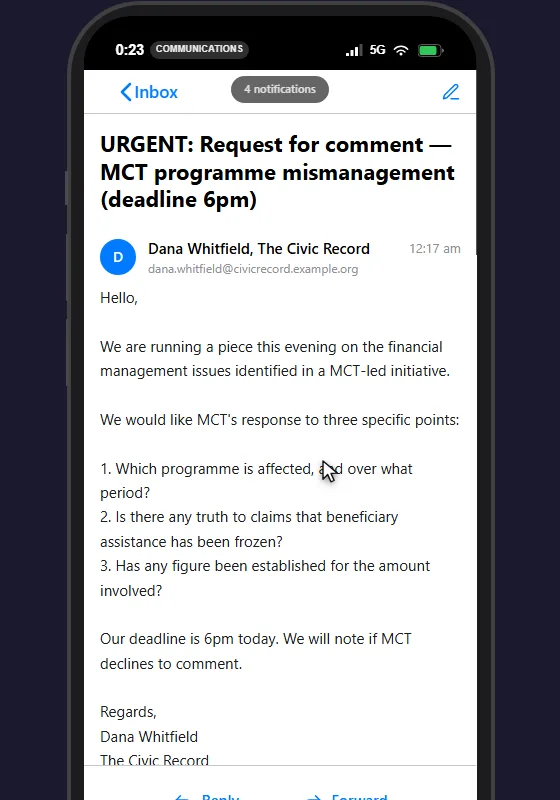
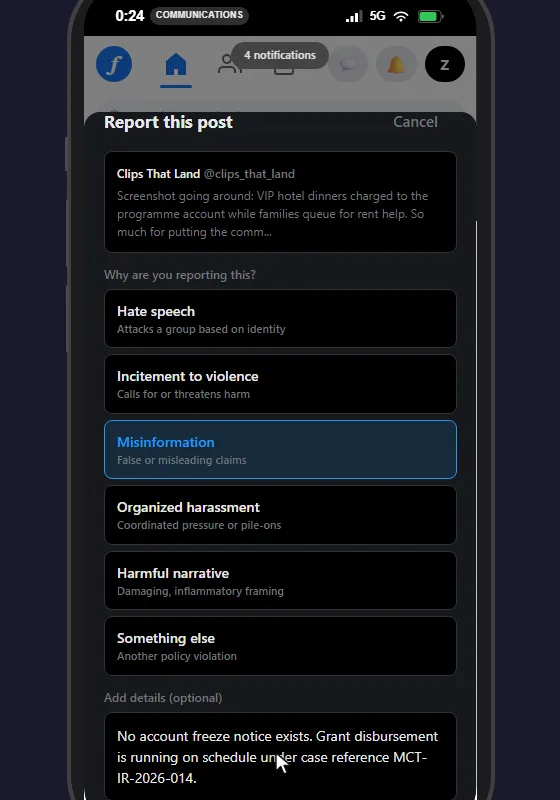
A claim your team could disprove in two minutes, at a quarter of a million views.
The inbox
A reporter with three specific questions, publishing at 6pm whether you reply or not.
The counter-move
Reporting the lie is scored on whether the cited fact actually disproves it.
Recordings of a delivered exercise · scenario content is simulated
Key highlights
Four things that make it behave like a real crisis
These are the design decisions that separate an exercise here from a scripted tabletop,
and the reason your team cannot settle into a comfortable answer.
01
Multi-agency coordination
Crises do not respect a single jurisdiction, and operational success usually depends
on coordinated action across several. Every participating agency works inside one
shared environment, entering decisions concurrently rather than waiting its turn. The
pressure lands where multi-agency response actually fails: asset deployment across
organisations, communication workflows, and joint command.
01
Multi-agency coordination
Read
02
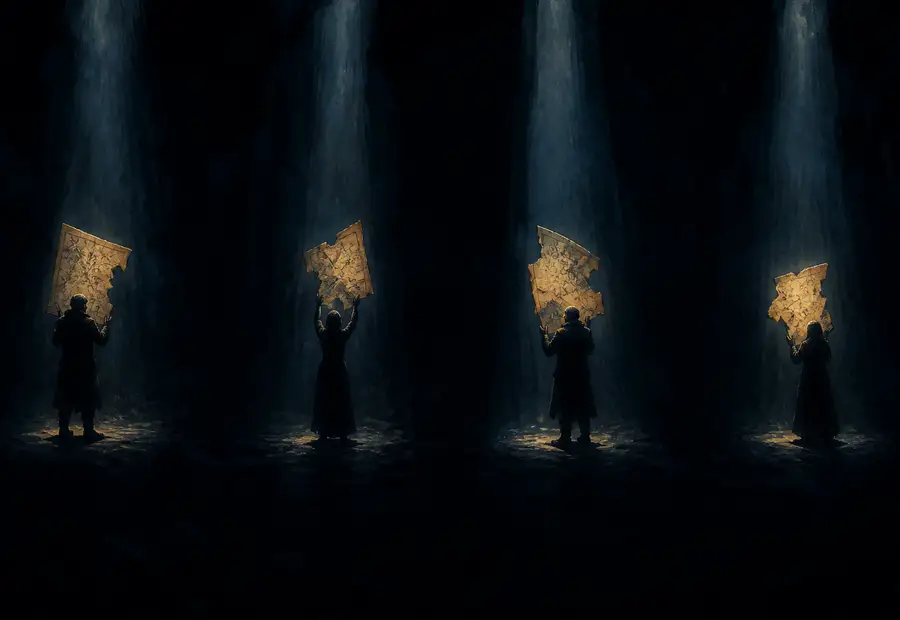
Information asymmetry
No agency ever holds a complete assessment of the theatre, so nobody is given one.
Information is deliberately partitioned into role-specific intelligence streams,
stripping out the artificial clarity that makes conventional exercises easy. What is
left is the real bottleneck: whether teams can build the protocols to validate each
other’s information quickly enough to construct a shared operational picture.
02
Information asymmetry
Read
03
Real-time adaptive injects
There is no storyboard to work through. A condition-dependent engine evaluates what
participants actually do and branches the scenario in real time, so the incident
escalates or settles according to the speed and quality of the response. That removes
predictability entirely. The trajectory follows the decisions, not a script.
03
Real-time adaptive injects
Read
04
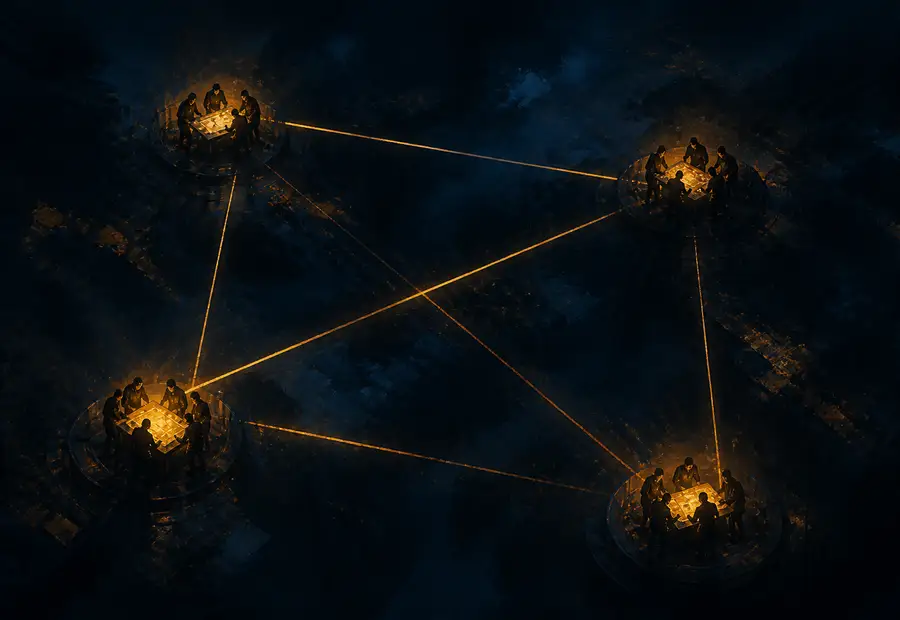
Team interdependency and storyboard synthesis
Operational domains are interdependent, so no decision is made in isolation. One
team’s intervention alters the conditions every other team is working in,
because a central synthesis layer feeds the output of each module straight back in as
live input to the others. Separate operational threads run as a single engine, and
teams have to absorb the compounding friction their counterparts create.
04
Team interdependency and storyboard synthesis
Read
Inside an exercise
What your people are actually doing
Not discussing a scenario around a table. Working a live picture, defending public
statements, and watching a conversation they do not control.
Command works the picture
Positions, cordons and priorities change as the incident develops, and each team
only sees the part of it they have been told.
Comms defends every statement
Anything your team says publicly is checked against what the scenario knows to be
true, and challenged when it does not hold.
The public conversation runs regardless
A simulated feed, inbox and news cycle carries on with or without you, and
misinformation spreads faster than corrections.
Illustrations, not screenshots
Exercise types
Three ways to put your team under pressure
Same scoring and the same report in every case. We recommend a format once we
understand what you are trying to prove.
Type 01
Multi-agency coordination
Tests the handoffs between your own functions, and with the external
agencies you would actually depend on. Each team sees a different slice of the
truth.
Deliberate information asymmetry between teams
Role-scoped channels, resource requests and negotiation
Best suited to command groups and executive teams
Type 02
Site and public safety response
For organisations responsible for physical sites and the people in them. A live map
of a real location, with a crowd simulation running underneath that reacts to
every decision.
Evacuation and cordon decisions with modelled consequences
Casualty condition deteriorates while decisions are pending
Built on real building footprints and street layouts
Type 03
Corporate Crisis
For communications, legal and leadership. A simulated feed, inbox and news cycle
turns on your organisation while misinformation moves faster than your approval
chain.
Simulated posts, direct messages and news coverage
Every public statement is fact-checked against the scenario
Hostile actors that respond to what you actually say
Built for organisations that cannot afford a first attempt
Government & defence
Inter-agency coordination and public information under political and media pressure.
Typical exercise
Coordinated attack during a public event, with competing agency priorities.
Emergency services
Mass-casualty response, cordon and evacuation decisions, multi-service command.
Typical exercise
Explosion at a crowded venue with a suspected secondary device.
Critical infrastructure & utilities
Service loss, cascading failure and communicating with a public that needs answers.
Typical exercise
Extended outage affecting hospitals and transport, cause unknown for hours.
Corporate crisis & communications
Product harm, data compromise or executive conduct playing out in public in real
time.
Typical exercise
A safety allegation goes viral before your own investigation has confirmed anything.
Media & public affairs
Verification pressure, misinformation, and reporting responsibly under uncertainty.
Typical exercise
Fabricated footage of a live incident spreading faster than official confirmation.
Not on this list?
The scenario is built from your material, so the sector matters less than the risk.
If you can describe what keeps you awake, we can build an exercise around it.
Scenarios are invented. They are built to resemble your exposure closely enough to
be uncomfortable, without documenting a real target, a real vulnerability or a real
operational plan.
Nothing touches a real platform
The feeds, inboxes, news outlets and messaging your people use during the exercise
are all simulated inside the environment. Nothing a participant posts can reach the
public internet or a real system.
Settled before anything is built
Exactly what material you share, and what is retained once the exercise is over, is
agreed at scoping rather than assumed. Bring your security team to that call.
Questions
Before you take this to your leadership
How is this different from the tabletop exercise we already run?
A tabletop is usually a structured discussion following a fixed script, closed out
by a subjective debrief. Here the situation advances on a clock and reacts to what
your team does or fails to do, so late decisions have consequences you can see. The
debrief is then assembled from measured decisions rather than from what people
remember agreeing.
Who designs and runs it?
A Prophyion risk consultant. They build the scenario with you from your own
material, facilitate both simulations, and present the scored after-action review.
You are not being handed software to operate yourself.
Do our people need training on the system first?
No. Participants receive a role briefing and work in a browser. The interface is
deliberately plain, because the exercise is testing judgement and coordination, not
anyone’s proficiency with a tool.
Can you build it around our existing crisis plan?
That is the preferred input. The exercise is most valuable when it tests the plan you
would genuinely follow, including the assumptions inside it that have never been
put under load.
How long until the first simulation?
Most of the elapsed time is your review, not our build. Once we have your material a
draft scenario comes back quickly, and we then iterate until you are satisfied it
reflects your real exposure. We will give you a firm date at the scoping call.
What exactly do we hold at the end of it?
A scored after-action review covering both simulations: a narrative of what
happened, metrics per team and participant, the complete decision timeline, and
prioritised recommendations. Exported to PDF or Excel for a board or audit pack.
What does an engagement cost?
We go through it at the scoping call, once we know which format you need and how many
people are taking part. An engagement is quoted as a single figure covering the
scenario, both live simulations and the scored after-action review, so there is
nothing to reconcile afterwards.
Get started
Start with a scoping call
Tell us what you are actually worried about. We will come back with a scenario
outline, a recommended format, and what an exercise would look like for your team.
A person replies, not an automated sequence.
No commitment, and nothing gets built until you approve the scenario.
Bring your security or procurement lead if it helps.
Prefer to circulate something internally first? Say so in the form and we will send
a short summary you can forward.
Enquiry received
Thank you. We will be in touch shortly to arrange a scoping call, usually within
one business day.